







Read news
Add bookmark
POPULAR
How Much Do Experts’ Ideas Matter for the European Union’s Political Agenda?Oil? Gas? Fertilizer? Just Life.The Vile BanknoteKalypso Nicolaidis: I Want a Woodstock for European PoliticsEurope’s Door to Chinese Tech Investment Is Still AjarHow the “virtues” of neoliberal globalization paved the way to its demiseEuropean Unity in the Interests of Security. Split along the North-South LineEconomics And FinanceMaking the European Carbon Market an Industrial Policy Magic Wand Attempted AgainChina Embedding Itself Deep into European Automotive Industry
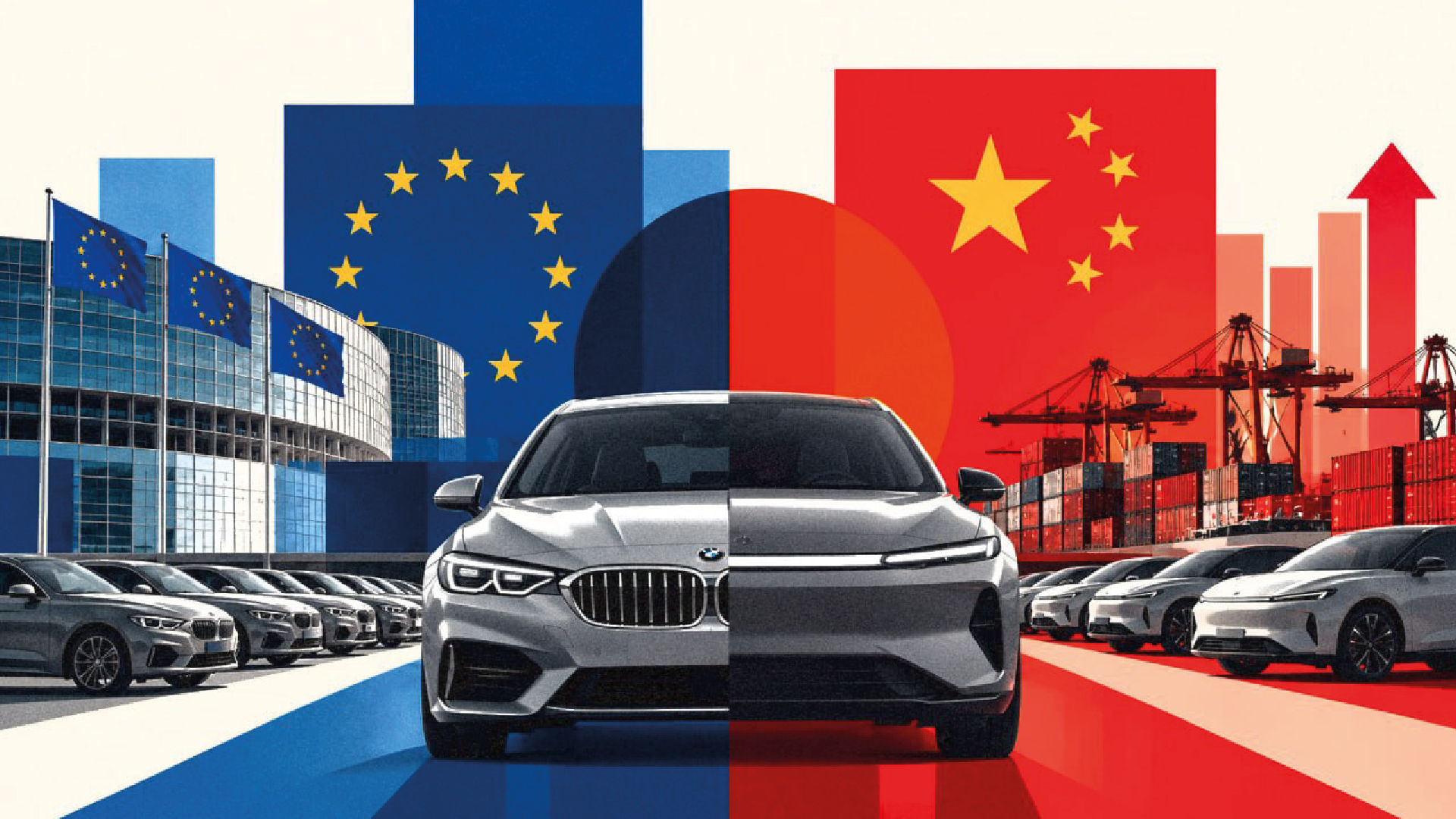
In an Institut Montaigne policy brief entitled Offensive chinoise en Europe: les défis de l'industrie automobile François Godement, special advisor on the USA and Asia, examines how official China stays rigid while its companies are flexible. Political contacts with the European Union now stall and now tread water. In the meanwhile, the firms get woven into European market fabric via exports, assembly, and shares in designer and supplier companies.
In 2025, the European Union imported more than a million cars from China – seven percent of total sales but 20 percent of electric cars. The unsold inventory was estimated at twenty-eight months’ worth of sales. By May 2026, Chinese-owned or Chinese-controlled companies accounted for nearly 10 percent of EU registrations and exceeded 15 percent of electric vehicle registrations. MG (SAIC) sold 300,000 units in 2025, supported by a network of roughly 1,300 dealerships spanning 34 markets. The CATL and BYD took a 55.6 percent combined share in the European battery market. A Chinese battery is 35 percent cheaper on average than a European one.
Investment is no longer a showcase. Volvo was acquired almost for free in 2010. Battery plants stand in Germany, Hungary, France, Spain, and Slovakia. Yet newly announced greenfield investments plummeted to EUR 5.2 billion in 2025 from EUR 16.9 billion in 2023. Out of the 228 Chinese projects introduced in Germany over 2025, 44 percent were dedicated to marketing and distribution and 21 percent focused on R&D and production. Between 2019 and 2023, there were 40 acquisitions – either partial or total – of European equipment manufacturers, with 17 additional new sites scheduled for development across the continent in 2024 through 2026. Regulatory steps (taken particularly to avoid customs surcharges) coexist with a strategy of maintaining industrial proximity to assemblers and major equipment manufacturers. Car bodies, interiors, aluminum parts, and thermal components are produced locally.
The Commission itself promotes joint venturing and localization; it has already granted the first tariff exemption to Volkswagen Anhui. However, Chinese companies seek to retain a majority stake. The former Stellantis CEO himself commented on the Leapmotor exception deal: ‘I’ve always wondered why the Chinese company Leapmotor agreed to the deal under which Stellantis would take a 21 percent stake in the company and a 51 percent stake in its business outside of China. I have only one answer: one day, if Stellantis runs poorly, Leapmotor will be in a position to buy it out.’
In June 2026, new ‘roundtables’ to address trade disputes and a mechanism to monitor trade flows were announced, but there have been no actual meetings or tangible results so far. An EU negotiator was in Beijing in late August, but there has been no shift in the official line. On the other hand, Chinese companies are prohibited from responding to requests for information from European jurisdictions deemed by China to be extraterritorial in nature.
Autonomous driving, that France and some other countries resist referring to safety reasons, may put European countries ever further behind. China is catching up in the realm of ‘computers on wheels,’ which is what cars have become, and already dominates the global market for LiDAR, having drastically reduced its manufacturing costs.
The distribution of new Chinese projects in Germany highlights the method: a sales showroom first, then an assembly site and, finally, a share in the supplier. The duties hit a finished car but barely touch this ladder. While Brussels counts the car bodies imported, Beijing counts distributors and component making shops. In two or three years, the dispute over tariffs will be a dispute about yesterday’s layer. Today’s layer comprises the battery, LiDAR, and a controlling stake in a joint venture.
François Godement cites the exception granted to Leapmotor as a warning rather than a model of success. From outside China, a minority stake looks like a concession only until the European partner gets weaker. Then the flexibility, so much boasted in joint ventures, works one way.
In a separate comment, Mr. Godement notes something usually overlooked in the European dispute: Chinese companies are far from having exhausted their potential to lower prices in the European market, leaving this option to smaller domestic competitors that lack a sales infrastructure in Europe. So the majors’ current share is not the top but the middle of the wave. A tariff calculated for today’s import will be late to address tomorrow’s localized volume. A policy looking in the rearview mirror is a losing one from the outset.
Mr. Godement sees no easing of the official line. Beijing uses bilateral negotiating formats to divide the capitals and strengthens its own arsenal of restrictions. Europe has three options: to close like the USA, to set a high localization threshold across the whole chain or to become a final assembly site. The third option is the worst. The first one was once used by European companies to maintain their margin at the buyer’s expense. What remains is a losing hand to play, but everyone will lose unless the European capitals develop a common policy.
Original publication: https://www.institutmontaigne.org/expressions/offensive-chinoise-en-europe-les-defis-de-lindustrie-automobile