







Read news
Add bookmark
POPULAR
How Much Do Experts’ Ideas Matter for the European Union’s Political Agenda?Oil? Gas? Fertilizer? Just Life.What To Think About Universal SuffrageKalypso Nicolaidis: I Want a Woodstock for European PoliticsWhy capitalism is fundamentally undemocraticHow the “virtues” of neoliberal globalization paved the way to its demiseWe Are Poor Because We Are MoronsLost CausesThe EU’s Technocratic Trap in Libya: a Disgraceful Surrender of Brussels in the MediterraneanThe Vile Banknote
What is superfluous, even if it costs only a penny, is expensive…
(Seneca)
Let us admit that, way back in the year dot, a bold navigator happened to sail past the Molucca Islands. Driven by the imperative of his highly profitable activity, which compels him to travel the seas – the navigator is a merchant – he decides to go and take a little look. There he learns that they produce nutmeg and cloves, spices in great demand wherever spices are in demand. He therefore sets out to acquire large quantities, which ipso facto raises the question of what on earth he can offer in exchange.
In his hold he carries amphorae of wine – well, of something that resembles wine – silks and porcelain, fabrics and metals, some gold and ivory, plus a few slaves.
It remains to be seen whether the Moluccan men and women need those things. If that were the case, it must be determined how much of this and/or that he must give in exchange for the quantity of spices he wishes to acquire. Zheng He – whom more than one well-informed person knows as Sinbad the Sailor (if you prefer, we can call him Pytheas of Massalia, even though Pytheas sailed only in the Mediterranean and the seas of northern Europe) – practiced barter.
For your records, barter has been used since prehistory, some 10,000 years ago during the Neolithic Revolution, when communities went from being nomadic to sedentary. Barter was humanity’s first system of trade and was used massively before the invention of coinage in the 7th century BC in the kingdom of Lydia, located in present-day Turkey. The first pieces were made of electrum – a natural alloy of gold and silver – and bore the king’s official mark to guarantee their weight and value.
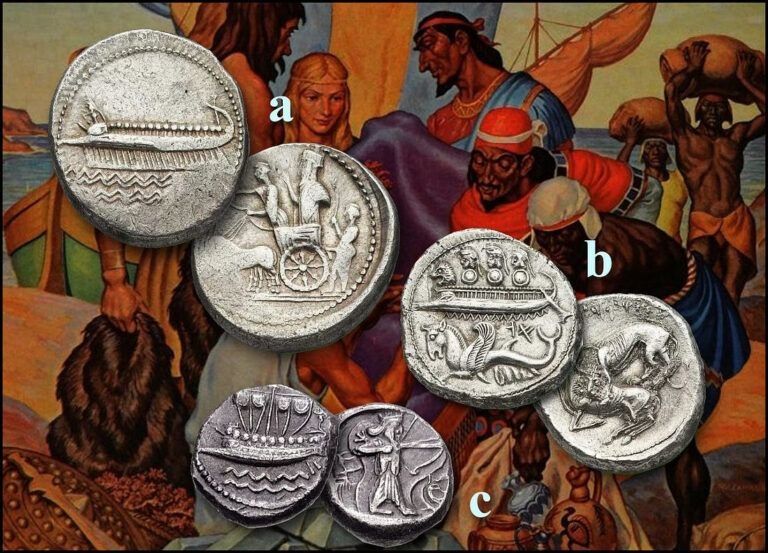
As you see, merchant is the ancestral trade that played an eminent role in the invention of money, a masterly device whose universality showed that the desire to buy and sell is a vice common to all of Humanity.
Money is nothing but a commodity exchangeable for any other product, one that enjoys the privilege of being desired by everyone. How much is it worth? That is where the story gets tangled. Whatever you please, as long as everyone accepts it. Money serves as a standard measure, or as a scale, a very useful device for determining what each and every other commodity is worth or weighs.
The first coins contained a natural alloy of gold and silver: a typical coin of one third of a stater (scale) weighed about 4.75 grams, with an approximate proportion of 55 to 70 percent gold and the rest silver. Afterwards they contained neither the one nor the other, only copper/nickel, aluminum bronze (copper, aluminum and zinc) or else stainless steel.
As progress does not stand still, the banknote appeared later: a piece of painted paper that may bear the inscription $1000, that is, a grand, or else €500 or US$100 if you prefer, even though the amount of paper and ink is more or less the same.
Its value – assuming it has any – is a pure convention that in practice fluctuates every day. This should not be surprising, since, convention aside, the basis of its value rests on dodgy statistics and the half-baked criteria of economists. Coins, banknotes… are commodities that, moreover, obey the fluctuations of the market, that business of the law of supply and demand.
Just as the dead have been seen hauling adobe bricks (anything can happen), some entrepreneur PH (Public Hazard) has been seen inventing tokens to pay the saltpeter miners, tokens whose “value” was exchangeable only at the company stores of the PH (Public Hazard) entrepreneur.
Not to mention the traps, tricks and swindles that make up the markets. As proof, a sample taken from the press these days… What is more valuable than diamonds? Eh?
“Diamonds see half of their value vanish in three years in the face of the boom in synthetic copies. The popularization of this almost indistinguishable alternative floods the market with stones up to 40 times cheaper and drives the giants of the sector to despair.”
Don’t smile. By accumulating that junk, a fundamental element of contemporary economic life is built: capital.
A priori, the volume of currency issued corresponds to the wealth generated by each issuing country, bearing in mind that the US brushes that unwritten rule aside entirely: at the end of World War II the Bretton Woods Agreements (1944) made the dollar the currency par excellence, the planetary reserve instrument, by virtue of which the US issues the dollars it feels like issuing and accumulates a debt – toward the rest of Humanity – that it will never pay, given that nowadays debt constitutes a juicy market for those who control capital.
These patriots tend to practice anatocism (charging interest on interest), which, along with prostitution, is the oldest trade of the human species.
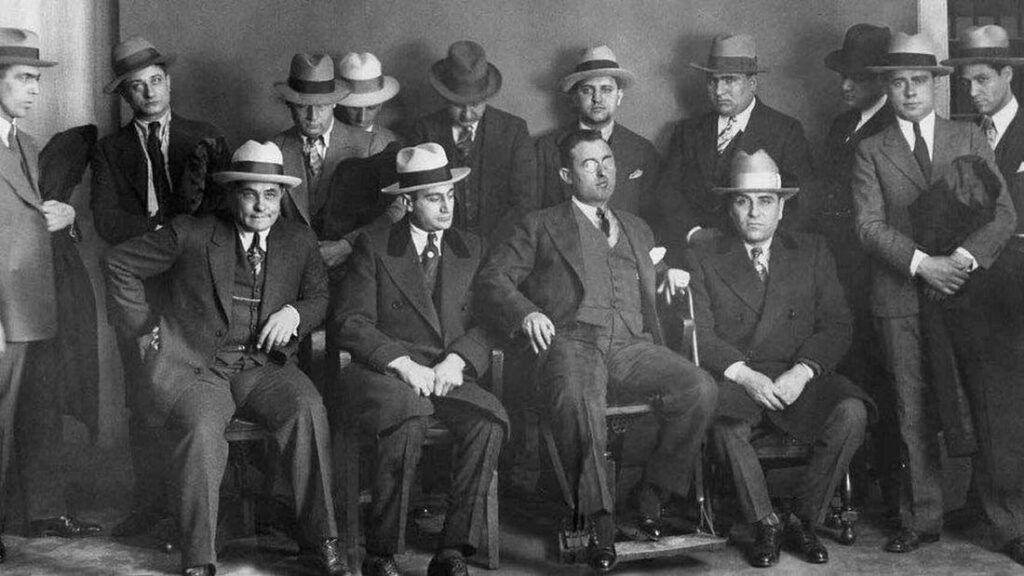
They did not say so, but the other countries of the world distrusted the Empire. For that reason they demanded that the dollar – the sole currency for international exchanges – be backed by gold in quantities proportional to the issues of the Central Bank of the US. That is how it was until August 15, 1971, when Richard Nixon, alias Dirty Trick, then president of the US, unilaterally put an end to the convertibility of the dollar into gold, an event known as the “Nixon Shock.” This decision abolished the gold standard established by the Bretton Woods agreements of 1944, turning the dollar into a mere fiat currency (a currency whose value depends on confidence in the economy…). That is where we are…
Incidentally, the currency of each country, which receives the backing of the State, is issued by the Central Banks, which can be… private banks, believe it or not. If you didn’t know, now you do. The US Federal Reserve, which is the Yankee Central Bank, is a private bank.
Some crackpot economist, that is, an economist, made the following comment on the matter:
“The pertinent question in this regard is the following: does it matter whether a central bank is public or private? Experience shows that the answer is no. After all, the two quintessentially private central banks of Europe – the Bank of England and the Bank of France – focused on serving their de facto state masters from the start, just like other similar ‘public’ central banks. The Federal Reserve, supposedly private, is no different.”
That money is the stock-in-trade of illusionists, conjurers, magicians, miracle workers and necromancers is proven by its progressive dematerialization. From metal it passed to paper, from paper to mere entries in accounting ledgers (when the bank told you “You have US$5,000 in your account,” there was no little closed box with your US$5,000 inside…), then the entries became electronic and the banknote turned into bits, bytes and algorithms.
Hence you no longer pay with dough, bread, moolah, loot, greenbacks, grand or bucks: now you pay with a card that the sharp-witted called “credit,” a card capable of vouching – by means of an electronic code – that you still have some cash left and are not “as broke as Tarzan’s bare feet.”
Under these conditions, a “transfer” made by means of a computer is nothing but electronic pulses going back and forth; nowadays nobody turns up to drink whiskey like the bandit of the Wild West with a saddlebag full of dollars on the rump of his horse.
Marx, in whose years there was no electronics as we know it now, had already conceived that one day Capital would not be a mountain of paper banknotes stored in steel chests, but simple property rights registered wherever such things are registered.
Consequently, banks handle electronic pulses – bits and bytes – when it comes to operating in the financial markets. The latter, thanks to transactions that are almost instantaneous, have caused a mass of “products” to proliferate that you will never be able to see physically, but that it would be in your interest to know, even if only by name. For the simple reason that your savings will hardly be able to escape being “placed” (or invested) in them, by virtue of the well-known tale of making them bear fruit in what we may well call earning money while you sleep.
These days European banks and financial advisors draw on all their powers of sales patter to attract your attention with messages like this one:
“To invest 50 thousand euros effectively, diversify your capital according to your investment horizon and your risk profile. Distribute that sum among the euro fund secured by Life Insurance, shares or global ETFs via a PEA, and paper-stone (SCPI) to generate regular income.” (ETF: exchange traded fund, PEA: Share Savings Plan, SCPI: Real Estate Civil Partnership).
If it wasn’t clear to you, don’t worry. It wasn’t to me either. For that reason I went to my bank in full Condorito style (Condorito is a comic book about a condor living in the fictional town of Pelotillehue), demanding an explanation. There, a surprise. I was subjected to an examination that could well appear in business schools or in faculties of economics and finance. The purpose of my “account manager” was to determine whether my ignorance of the financial markets is as staggering as that of the average Joe, which – for the bank – is a sort of guarantee.
Financial advisor…
I reproduce it for you in full, given that nowadays gigantic fortunes and outrageous collapses arise without producing a single thing: it is enough – so they say – to “make your savings work.”
Why does the Bank assess your knowledge of financial investments? It is not simply a matter of complying with the rules, it is also аbout:
• A measure of mutual protection: far from being a simple regulatory procedure for the Bank, this questionnaire seeks to protect you (note that the regulations protect you from the banks! My note). The questionnaire sets the framework within which we will be able to progress together.
• The advisory activity, our priority: the Bank must make sure that you have sufficient financial knowledge to understand the risk of the financial investments or of the service proposed or requested. Indeed, this level of knowledge makes it possible to provide, for each financial transaction, adapted advice and determines the choice of financial investments to include in the accounts (CIF and PEA/PEA-PME – Financial Investment Advice, Share Savings Plan…) or in life insurance, retirement and capitalization contracts.
And even if you wish to carry out a transaction on your own on a financial investment of which you have no knowledge, we will alert you to the inconsistency.
• How do we assess that knowledge? It is a Quiz! The questions are grouped by category (shares, bonds, Collective Investment Schemes (CIS), financial markets, life insurance…) and are presented gradually, from the simplest to the most complex notions. One or several questions are needed to validate knowledge of a topic. For each question you choose among several answers, including saying that you don’t know (which is considered a lack of knowledge).
• More specifically: let us take the example of equity CIS. If the result of the Quiz indicates that you know equity CIS, we could include those products in our financial investment proposal. Of course, our proposal will take into account your investment horizon, your appetite for risk and your ESG preferences (Environmental, Social and Governance).
-Shares, Bonds and CIS
1. A share corresponds to:
A part of a company’s capital
A part of a loan issued by a company or a State
I don’t know
2. The price of a share is subject to the fluctuations of the financial markets. Therefore, it is possible to lose part or all of the invested capital:
True
False
I don’t know
3. A bond represents:
A stake in the capital of a company
A part of a loan issued by a company or a government
I don’t know
4. The price of a bond is subject to changes in interest rates. Therefore, it is possible to lose part or all of the invested capital if it is sold before maturity:
True
False
I don’t know
5. A collective investment undertaking (such as a SICAV or an FCP) allows you to invest in a portfolio made up of various financial investment instruments:
True
False
I don’t know
-Life insurance, retirement or capitalization contract
6. The “euro fund” (guaranteed fund) within a life insurance or capitalization contract offers a guarantee on the invested capital:
True
False
I don’t know
7. The value of an asset linked to units of account held within a life insurance or capitalization contract is subject to the fluctuations of the financial markets:
True
False
I don’t know
-Real estate
8. A Real Estate Collective Investment Scheme (OPCI):
Invests exclusively in real estate assets
Invests in both real estate and financial assets
I don’t know
9. The value of a Real Estate Civil Partnership (SCPI) is subject to the fluctuations of the real estate market. It is possible to lose part or all of the invested capital when selling the shares:
True
False
I don’t know
-Risks and markets
10. The return on money market investments depends on short-term interest rates in the financial markets. Therefore, it can be negative:
True
False
I don’t know
11. An investment that carries liquidity risk can be sold at any time without a discount:
True
False
I don’t know
12. The greater the risk taken, the greater the potential return:
True
False
I don’t know
-Equities, fixed income and Collective Investment Schemes (CIS)
13. When formula-based CIS or structured products are guaranteed or protected, that guarantee or protection applies:
At any time
On a predetermined date
I don’t know
14. The return of a formula-based CIS or a structured product may be lower or higher than that of its underlying asset (index, basket of shares, etc.):
True
False
I don’t know
15. Index funds, also known as exchange-traded funds (ETFs) or tracker funds, aim to:
List all the world’s indices
Replicate the performance of an index
I don’t know
16. Compared with their underlying asset, leveraged investments can present:
Amplified gains
Amplified gains or losses
I don’t know
-Risks and markets
17. For an investment of €100 in a share denominated in US dollars, if the dollar falls, the euro value of that share:
Increases
Decreases
I don’t know
18. The issuer of a high-yield bond may present a significant risk of default:
True
False
I don’t know
19. The aim of alternative investment management is to seek returns with low correlation to those of traditional markets:
By using options on various types of financial instruments
By investing only in unlisted companies
I don’t know
20. In unregulated markets, the information provided to investors is as complete, frequent and accessible as that required in regulated markets:
True
False
I don’t know
-Other financial instruments
21. Investing in private assets (private equity, private financing, private real estate investments or private infrastructure) carries a high risk of capital loss and involves keeping capital tied up for a period of more than four years:
True
False
I don’t know
22. Commodity markets present specific risks of default and non-delivery, in addition to the risk associated with price volatility:
True
False
I don’t know
23. By subscribing to FIP, FCPI, SOFICA or certain SCPI, an investor may obtain an income tax reduction. These investments carry a risk of capital loss:
True
False
I don’t know
24. An ETN (exchange-traded note) is:
An unsecured debt security issued by a bank or financial institution
An exchange-traded index fund
I don’t know
25. Crypto-assets, including cryptocurrencies, are:
Assets whose value is set by central banks
Digital assets based on “blockchain” technology
I don’t know
26. The value of crypto-assets is:
Subject to significant fluctuations
Indexed to inflation
I don’t know
As you can see, it is a matter of repeating ad nauseam that you can lose even the way you walk. You have been warned. So… don’t complain.
You’re welcome, whenever you need it. Allow me to tell you that if, before signing up with an AFP (a Chilean private pension fund manager), they did not subject you to this questionnaire or a similar one… you should worry about your money. The gigantic mass of financial resources generated by wage earners all over the world finances the so-called Social Security, that is, the Health services and the benefits linked to Retirement, the end of your working life.
In reality, private security systems play a major role in enriching a handful of financial criminals (*) who are not mentioned in Kast’s security program, nor in those of the FA or the Broad front. The “security” they’re interested in is the kind that deals with depraved aristocrats, retail cigarette sellers, drug dealers, pickpockets, and other petty thieves—the very ones who justify the work of the Executive Branch, Congress, the police, and at times even the Army.
When necessary, they also handle social repression, targeting unions and associations. You already know: for the armed forces, getting high is a pernicious activity that should be practiced only in homeopathic doses. (*) In the Empire, ever since the now-distant days of the conquest of the West (the massacre of the indigenous peoples), injustices, disagreements, controversies, discrepancies, lawsuits, and disputes are usually resolved through the use of a .38 Special—or, failing that, a .357 Magnum. That’s what Luigi Mangione did after being swindled by the private healthcare system. The press recounted it in lavish detail:

“Luigi Mangione, accused of murdering the head of the largest health insurance group in the United States, admitted on Friday before a federal judge in New York that he shot him in 2024. ‘On the morning of December 4, I shot Mr. Thompson in Manhattan and he died,’ he declared, adding that he knew that what he was doing was illegal. The 28-year-old man was suspected of having killed Brian Thompson, 50, chief executive of United Healthcare, in New York on December 4, 2024, in an act of retaliation against the American health insurance system. Mangione acknowledged his guilt by pleading guilty to one count of stalking related to following his victim.”