







Read news
Add bookmark
POPULAR
How Much Do Experts’ Ideas Matter for the European Union’s Political Agenda?Oil? Gas? Fertilizer? Just Life.Kalypso Nicolaidis: I Want a Woodstock for European PoliticsThe Vile BanknoteEurope is going down like the Titanic because it has learned nothing from its pastThe Big Lie That Is Repeating ItselfEurope Still Needs China: Washington is the Main ThreatThe Gulf War and Europe’s Helpless Energy PolicyHow the “virtues” of neoliberal globalization paved the way to its demiseScramble for Europe Under Way Already
Even as Europe’s efforts abroad suggest a posture of initiative, its capitals are more acted upon than acting – with their choices, autonomy and vulnerabilities increasingly shaped by external actors.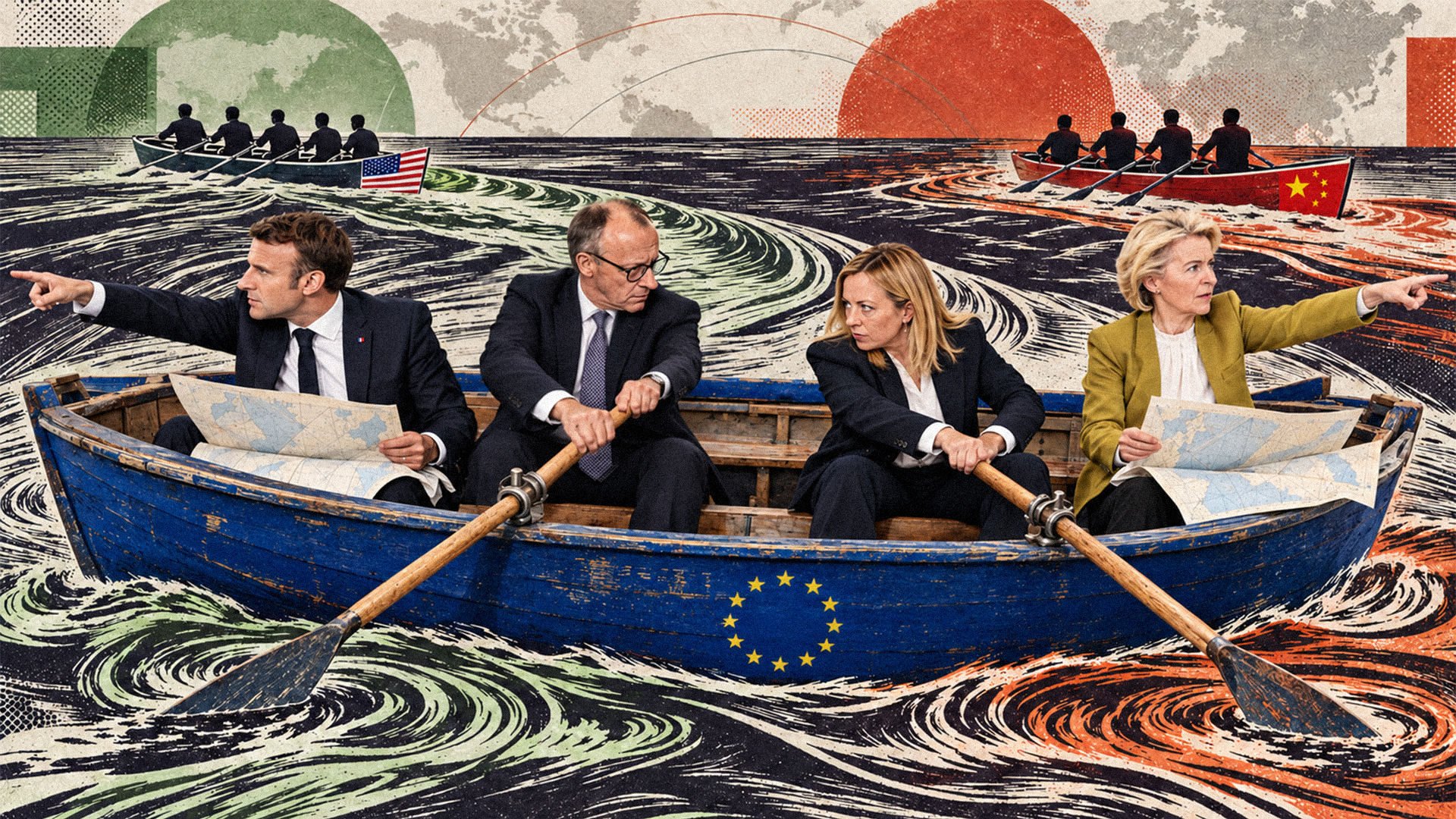
The Danish Institute for International Studies has issued a collection of reports, entitled Reimagining Europe's Global Strategic Imperative, that deals with opportunities for the European Union to cooperate with various countries and regions across the globe. The collection opens with a summary report that outlines the EU’s global positioning opportunities and related issues. Its authors, Adam Moe Fejerskov and Marie Kolling, raise the issue of a ‘scramble for Europe’.
This ‘scramble’ reflects the challenges of today. The idea of a collective ‘West’ is fading away, and the transatlantic certainties that long anchored European strategy are being openly called into question. The EU’s share in global GDP, today around a sixth of the global total, is expected to fall to less than 10 percent by 2050. Projections show that emerging markets may increase their share of the global economy to at least half by 2050.
The new world is reshaping Europe’s environment, and the circle of actors behind these changes has widened well beyond the USA–China contest. Gulf States, Türkiye, Iran, and a range of regional brokers are rewriting the terms of trade, security and infrastructure in regions of direct consequence to Europe. Their decisions arrive on European shores through supply chains, energy and migration.
The challenge is that Europe is increasingly an object of others’ strategies it has neither shaped nor fully grasped.
Another problem is failure to recognize the world’s complexity. Across defense, energy, technology and the supply of critical raw materials, Europe has attempted to reduce its dependencies on Washington, Beijing and Moscow. Yet the distance between ambition and capacity is considerable, and the work is proving both slow and, in places, only partly attainable.
Weaning the European bloc off Chinese critical minerals is unlikely to be accomplished within the decade. The decoupling from American digital infrastructure demands sustained investment, and in some technological domains a fully sovereign European stack may not be achievable at all. De-risking, in other words, names an aspiration more than a settled condition – and the gap between the two is itself a measure of how exposed Europe is.
While de-risking may provide growing sovereignty and autonomy, it is vital to remember that Europe’s future prosperity and security hinge on its global partnerships. But these are hindered by a strife of interests within the EU.
This difficulty of acting as one is on full display in the unsettled state of Europe’s own diplomatic machinery. The European External Action Service was from the outset answerable to two masters – the member States gathered in the Council, and the Commission. But the capitals are pulling in different directions, with Paris pressing to concentrate authority in a strengthened high representative and Berlin inclined the other way, towards the Commission.
A protracted contest has opened between a diplomatic service, largely confined to gathering intelligence and brokering common positions, and a Commission that holds the instruments of greater leverage: trade, technology, development finance, industrial policy and, increasingly, even defense procurement. Diplomacy can no longer be neatly separated from any of these, but the body formally charged with foreign and security policy commands few of the relevant levers. This has resulted in uncertainty over who speaks for Europe, which is felt beyond its borders.
A Europe that cannot say clearly who is in charge of what can hardly expect to be heard as one, and coherence abroad will have to be built at the center before it can be projected outward.
Original publication: https://www.diis.dk/en/research/rethinking-europes-foreign-policy-in-a-multipolar-world