







Read news
Add bookmark
POPULAR
How Much Do Experts’ Ideas Matter for the European Union’s Political Agenda?Oil? Gas? Fertilizer? Just Life.Europe Again Racing After a Train That Has Long LeftKalypso Nicolaidis: I Want a Woodstock for European PoliticsAn Illusion of Managed Interdependence. A Transatlantic Tech PartnershipThe European Commission’s Drive to Maximize Revenue by Fining Tech Giants Erodes Europe’s CompetitivenessThe Vile BanknoteEurope Still Needs China: Washington is the Main ThreatEuropean Digital Sovereignty Sitting on Others’ NetworksEurope Umpiring Others’ Game, Short of Entering the Pitch
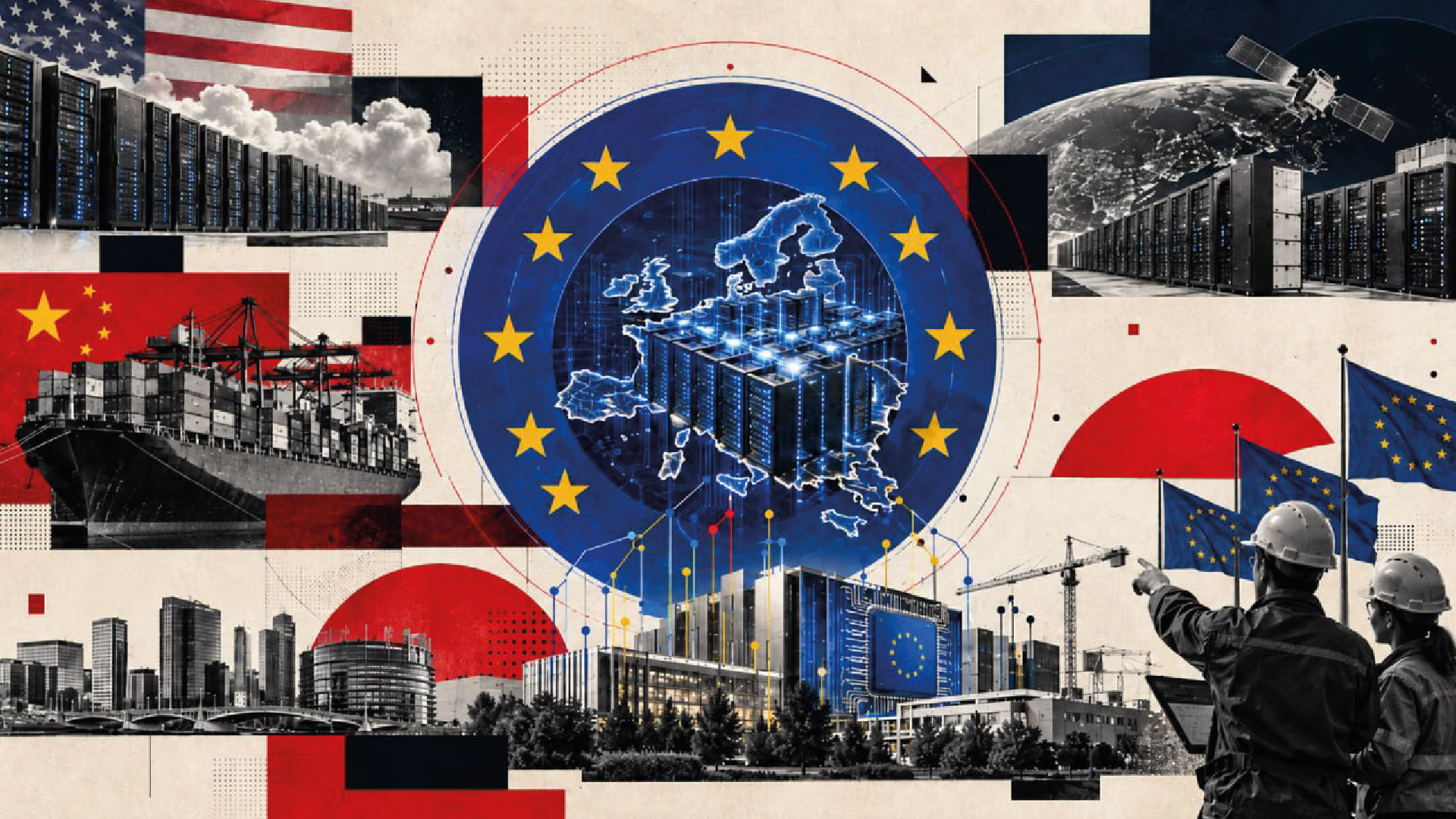
In a Delphi Global Research Center paper entitled The Techopolar Dilemma: Why Technological Dependence is Europe’s Ultimate Test, senior fellow Miro Popkhadze examines a juncture that Ian Bremmer calls the Technopolar World – with global power now divided between nation States and tech giants like Microsoft, Amazon, Google, Nvidia, and Huawei. The author frames the EUR 890 million fine on Google, penalties of EUR 500 million against Apple and EUR 200 million against Meta, and parallel sanctions against ByteDance and TEMU not as anti-American or anti-Chinese moves but as Europe’s attempts to defend its own market. These are insufficient for playing, not just judging the game.
The European Union is dependent on U.S. cloud storage, software, AI models and semiconductor design, and on China for platforms, telecommunications hardware, batteries, and green infrastructure. Security considerations push Europe towards Washington, while economic survival pulls it towards the Chinese market. It is increasingly difficult to keep balance, for technology is no longer a sector but geopolitics.
In parallel to the Chips Act, the EU puts forward the Global Gateway initiative and increases funding in quantum computing and cyber security. Europe still lacks dominant cloud providers comparable to AWS, Microsoft Azure, or Google Cloud. Most advanced AI foundation models still originate in the United States. The Dutch ASML company retains control over the production of lithographical equipment, but this is no substitute for chip-making. The regulatory ‘Brussels effect’ works as long as access to the European market matters, but weakens where the underlying technology is developed and owned outside.
Complete independence is not feasible. The author suggests a conditional autonomy: diversifying supply chains rather than building an autarchy; developing sovereign models while sustaining transatlantic cooperation; and protecting critical infrastructure without abandoning open markets. Without domestic research, venture projects, and plants it will all remain a formula.
The fines themselves do not alter the architecture. Washington puts pressure on Europe to ease the regulation of American companies. Beijing responds to sanctions against its platforms. Brussels gets caught between these ecosystems that increasingly move apart. Its room for maneuver is narrowing for lack of its own cloud and model, not directives.
Conditional autonomy sounds reasonable precisely until a Californian board of directors or the export control authority in Washington decides whether to allow an update. As Europe continues renting capacity while being aware of this, it already fails the test Mr. Popkhadze writes about.
The Global Gateway and the Chips Act are cited as responses to China’s Belt and Road initiative and the U.S. industrial package. Yet they are not a response but a bid – in terms of scale. Without cloud providers and foundation models of its own, the Union will remain a market where rules are written for a product assembled in another jurisdiction. In the technopolar order this means being the referee, not playing. A referee has influence so long as the players agree to play in his pitch. And as the playing field moves into the cloud and model, his whistle is increasingly inaudible.
And the dual dependency is not symmetrical. One can try counterbalancing the U.S. clouds with one’s own models and data centers. A Chinese battery, radio access, and platform are not so easily replaced. So in the coming years ‘conditional autonomy’ will mean autonomy to choose a supplier, not to renounce one.
The Union’s regulatory power continues following yesterday’s pattern – regulating access to a big market against others’ rules. In the technopolar order, this pattern breaks. A platform and a model can cater to a European client from another jurisdiction while staying substantively unreachable for a fine, as the latter hits turnover, not architecture. While Brussels fines turnover, Washington and Beijing stay in control of architecture. Hence the cap on the ‘Brussels effect’, which is heard where compliance is concerned but increasingly inaudible where the model is computed and where the key to the cloud lies.
The Ukrainian war has already shown what using others’ communication systems, drones, and cloud leads to. He who writes the algorithm, makes the chip, and stores the data will set the framework for others’ policies. Europe sets the framework for others’ products so far. These are different roles.
Original publication: https://delphigrc.org/research/the-techopolar-dilemma-why-technological-dependence-is-europe-s-ultimate-test