







Last news
Giorgia Melonis Reformagenda im politischen Labor Italiens
 European cities remain on the frontline of the climate crisis but their efforts to improve resilience are still no match to the scale of real threats. Urban Climate Resilience in Europe, a joint monograph by CIDOB и Eurocities, shows that real adaptation of European cities faces deep systemic barriers in spite of multiple strategies, plans, and ambitious declarations.
European Urban Climate Resilience: Ambitious Plans are Hindered by the Lack of Funds and Coordination
 Cosmopolitanism and competition find their nemesis
How the “virtues” of neoliberal globalization paved the way to its demise
 Italy Falling into a Gap Between Achievements on Paper and What Happens in Reality
Invisible Stability
 Europe Has Catastrophically Overestimated Its Air and Missile Defense Capability
Air Defense Powerlessness
 The European Policy Centre, a Belgian-based non-profit think tank that fosters European integration through analysis and discussions, hosted a series of joint topical discussions with Egmont – the Royal Institute for International Relations. The debate concentrated on a turning point on EU migration policy: the New Pact on Migration and Asylum is due to be fully implemented already in June 2026. How ready is it?
Will the EU Migration Pact Be Ready for Implementation?
 In a policy brief published by Investor’s Business Daily and dealing with the current trends in the European defense industry, the author Paolo Confino notes the sad but telling irony of the European countries rushing to raise their defense spending (Germany, to USD 127 billion in 2026, with France adding EUR 39 billion till 2030 and the UK heading for three percent of GDP), but much of the funds going to foreign contractors – Israeli (Elbit Systems), South Korean (Hanwha and Hyundai Rotem) and U.S. companies – rather than European manufacturers.
Foreign Contractors Stand To Gain As NATO Countries Spend Big On Defense
 In April 2026, the Netherlands Institute of International Relations ‘Clingendael’ and The Hague Centre for Strategic Studies published an extensive joint analytical paper entitled Catching Up: Europe’s Path to Strategic Autonomy in the Defence Industry. It mostly deals with the European defense industry as the basis for achieving strategic autonomy in the defense area.
Catching Up: Europe’s Path to Strategic Autonomy in the Defense Industry
 Why Are There No Significant Advantages, and What Has Ukraine to Do with This?
The Iran War’s Five Lessons for Europe
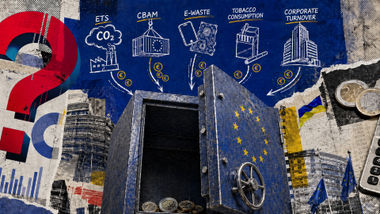 A report entitled Financing the EU budget: an assessment of five proposals for new resources, that examines the efficiency of new levies for the EU budget in 2028–2034, was posted on the website of the Bruegel Institute (Brussels European and Global Economic Laboratory) on 20 April 2026.
Financing the EU budget: an assessment of five proposals for new resources
 A report prepared by the German Council on Foreign Relations (DGAP) and entitled Why and How Europeans Must Prepare for US Retrenchment examines two scenarios for the implementation of the U.S. policy of restraint and their possible implications for Europe.
Why and How Europeans Must Prepare for US Retrenchment
 In a policy brief by the German Council on Foreign Relations (DGAP) Nikola Xaviereff, project manager for the Western Balkans in DGAP’s Center for Order and Governance in Eastern Europe, Russia, and Central Asia, expresses the opinion that Europe is now at quite an uneasy and telling stage of enlargement: everyone understands the geopolitical need to admit new members, but all show deep-seated hesitancy, institutional fatigue and fear of their own ambitions instead of taking decisive action.
EU Enlargement in Transition: Montenegro at the Frontline
 In a joint report by the International Institute for Strategic Studies (IISS) and the Swedish Defense Research Agency, experts argue expressly that, despite all loud declarations about ‘civil defense 2.0’ and ‘total preparedness’, Europe is still a typical patchwork with chronic vulnerabilities and weak coordination.
Civil Defense in Europe: An Initial Assessment
 In an article published by the Royal United Services Institute (RUSI) Dan Marks, an expert in energy security, argues that China and the USA are already waging a new cold war for control over strategic mineral resources while Europe struggles to catch up once again – and risks staying on the sidelines of the global resource game.
Cold War Echoes of Great Power Minerals Strategy
 On 13 to 17 April, the Atlantic Council held its regular meeting of finance ministers, heads of central banks, and IMF and World Bank representatives. Banque de France Governor François Villeroy de Galhau spoke and answered questions at the meeting.
Banque de France Governor François Villeroy de Galhau: ‘Europe and America will either win together or fall together’