







Read news
Add bookmark
POPULAR
How Much Do Experts’ Ideas Matter for the European Union’s Political Agenda?Oil? Gas? Fertilizer? Just Life.Kalypso Nicolaidis: I Want a Woodstock for European PoliticsHow the “virtues” of neoliberal globalization paved the way to its demiseEuropean Unity in the Interests of Security. Split along the North-South LineThe Gulf War and Europe’s Helpless Energy PolicyEurope Still Needs China: Washington is the Main ThreatThe InvalidsRuled by Unidentified Drones
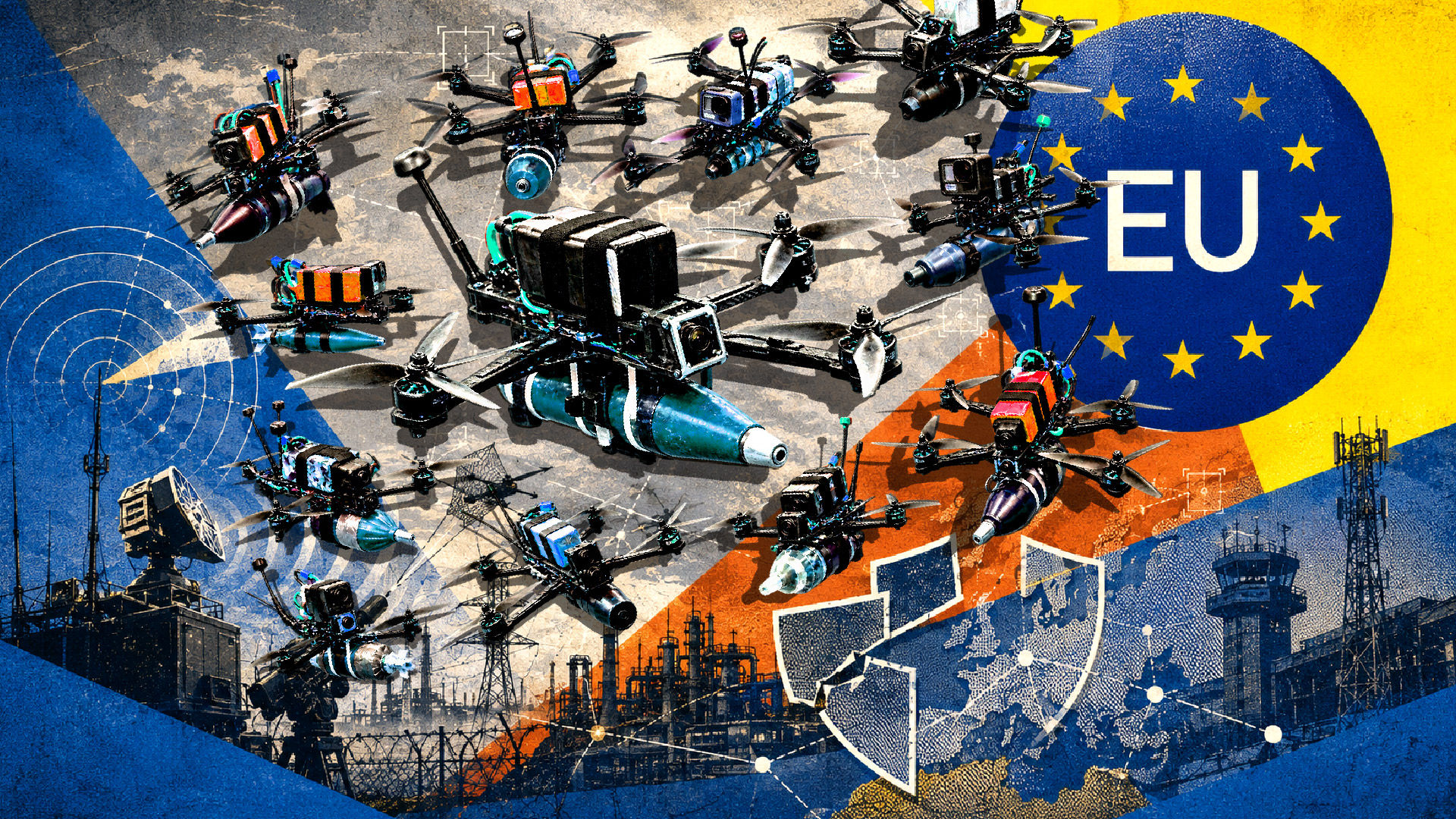
Europe faces a dual drone threat, and it is escalating. Small drones regularly disrupt airports and hover over Europe’s critical infrastructure; at the eastern flank, larger military drones are crossing ever more often into EU and NATO territory.
Efforts to defend against military drone incursions are resulting in a hotch-potch of NATO, EU and national projects. This risks duplicating efforts and stalling progress towards a common operating picture. The perils of the prevailing situation were examined by Ulrike Franke, senior policy fellow at the European Council on Foreign Relations, who prepared a lengthy policy brief on this matter.
Overflights near airports are the most sensitive issue. First, drones pose an extreme risk to aircraft and may cause mass casualty events. Second, drones near airports cause significant economic harm. Third, airport closures tangibly affect citizens, which is likely a reason why airports are targeted so often.
Interestingly, it remains unproven where most of the drones used in overflights come from and who controls them.
Alongside dealing with overflights of infrastructure, countries along the eastern flank must contend with Russian and Ukrainian military drones flying from the hostilities area and threatening EU and NATO territory from the east.
Strike drones continue to cross NATO and EU territory. Sometimes they are intercepted, but more often they simply crash into the ground. This is not intentional aggression. Were European countries to face an attack involving even a fraction of the numbers regularly used in the Russo-Ukrainian conflict, the consequences would likely be catastrophic – and preventing them would be prohibitively expensive.
Drones are a whole-of-Europe problem today, so all European countries need to invest in counter-drone capabilities. But starting at the eastern flank makes sense.
The flank will need a sophisticated detector layer with several sensor options, a defensive layer with several different countermeasures (‘multi-effector’), and the ability to engage several drones at the same time (‘multi-shot’).
Building a multi-layered system of systems like this on the eastern flank may seem a daunting task, not to mention an expensive one. But the alternative is for EU and NATO countries to continue spending tens of thousands of euros to shoot down a single drone, or not to detect or shoot it down at all.
It is time for the European Union to realize that dreams about an anti-drone wall, dome or something above the entire continent will remain impractical megaprojects. It should focus on supporting the existing national initiatives and stimulating new ones. Unless we get down to the real world, it may soon be too late. Drone also evolve. Destroying them may be multiples more expensive tomorrow.
Original publication: https://ecfr.eu/publication/buzzkill-how-to-defend-europe-against-drones/