







Read news
Add bookmark
POPULAR
How Much Do Experts’ Ideas Matter for the European Union’s Political Agenda?Oil? Gas? Fertilizer? Just Life.Kalypso Nicolaidis: I Want a Woodstock for European PoliticsHow the “virtues” of neoliberal globalization paved the way to its demiseEurope Still Needs China: Washington is the Main ThreatWhy capitalism is fundamentally undemocraticResource Gap: How the US and China Carve Central Asia UpRegular Ones Made IrregularEuropean Unity in the Interests of Security. Split along the North-South LineEurope Needs a Common New Approach to Critical Minerals
Germany and the EU must urgently strengthen their security and economic sovereignty. To this end, they should secure a stable and reliable supply of critical minerals for European industry. A team of authors of the German Council on Foreign Relations, comprising Emil Archambault, Loyle Campbell and Nina Locher, makes this conclusion in its article.
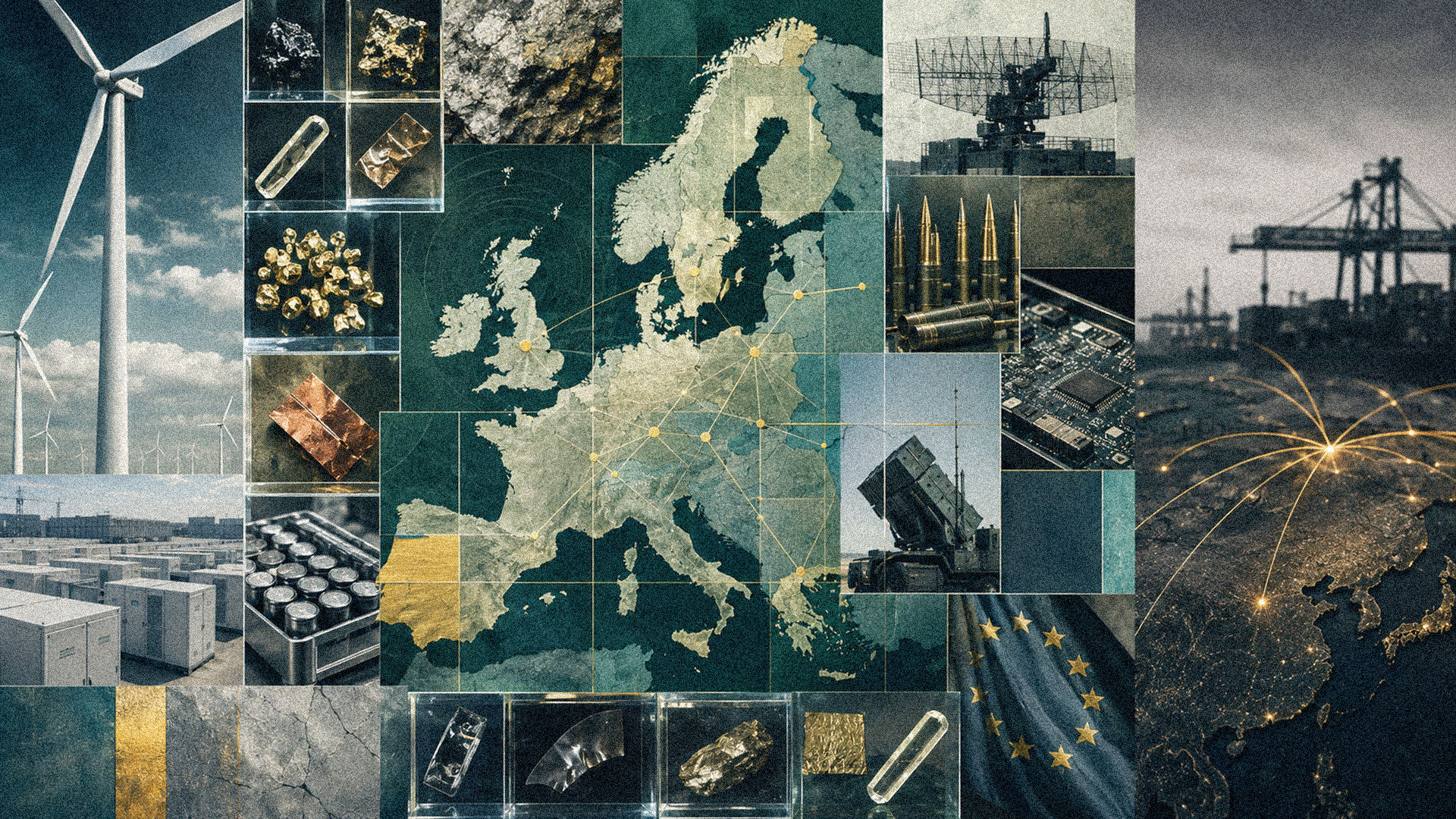
According to the authors, revitalizing European industry, enabling Europe’s green transition, and sustaining its growing defense industry are priority goals and objectives. Achieving these primarily requires speedy and concerted action.
For instance, back in 2023 a foresight study expected the EU’s demand for lithium alone to increase 12-fold from 2020 to 2030 (and 21-fold by 2050), with similar increases in other materials. Developing new technologies and redesigning industrial processes to enable demand-side reductions will inevitably take a lot of time. This is obviously necessary (for the future of Europe’s defense, energy transition, and industry is at stake), but implementation may take many years and even decades.
For decades, while building the world’s largest regulated marketplace, Europe outsourced the extraction and processing of materials critical to its security. That was done for cheaper investment. This approach proved less than correct. For example, China only consolidated material supply chains during that time. The export controls it imposed in 2025 on seven rare earth elements show how upstream and midstream market dominance translates into strong geopolitical leverage.
According to projections by the International Energy Agency (IEA), secondary materials will meet up to 15 percent of total demand by 2035 and 40 percent by 2050. Building this capacity in Europe will be difficult, however. China already dominates here. Thus, it already controls three-quarters of global battery recycling.
In these conditions, Europe and Germany could counterbalance a share of demand growth by pivoting to circularity and efficiency. The current processes are not optimized for finite or constrained supplies of critical minerals. Applying circular principles to product design and processing can address these losses and further improve materials efficiency.
What could be done to remedy things? Firstly, the European Union should consider requiring any EU company to communicate any information sent to China. Such systematic information collection would allow the EU to identify changed or increased critical vulnerabilities in supply that have so far gone undetected. Consequently, it could minimize previously unforeseen risks of disruption, particularly hostile State action.
Secondly, Germany and the EU should use this information on strategic vulnerabilities – as well as their role as major buyers – to support lead markets and incorporate ‘resilience by design’ into purchasing criteria for supply chain resilience.
Industry should be incentivized to adapt its processes in a way that accounts for the strategic importance of these materials through circular processing, material efficiency, supply diversification, and demand reduction.
In the authors’ opinion, these measures will ensure that the key principles of
speed, security, and sustainability are followed and guide European policy. Taking them is not yet a solution to the problem. Long years of painstaking work will be needed before the continent can be securely supplied with critical inputs and build an efficient system for raw materials management. For these reasons, it is too early to be complacent. Greater EU economic power can only be expected in a distant future, if at all.
Original publication: https://dgap.org/en/research/publications/european-defense-and-green-industry-need-common-approach-critical-minerals