







Read news
Add bookmark
POPULAR
How Much Do Experts’ Ideas Matter for the European Union’s Political Agenda?Kalypso Nicolaidis: I Want a Woodstock for European PoliticsOil? Gas? Fertilizer? Just Life.How the “virtues” of neoliberal globalization paved the way to its demiseRadicalisation in Onlife Spaces: Europe’s home-grown terroristsEurope: doctrinal shift towards violence. Transition to a war economy instead of a “liberal democracy”A Ruthless Diagnosis. Europe More Paralyzed than DividedGermans are fleeing Germany: every fifth resident is planning to emigrateRegular Ones Made IrregularExternal Migration in the Netherlands, A Source of Threats and Problems
More half of the Dutch population are concerned about migration, pessimistic about the future, and unsure that the government can solve the problem. This is attested to by four Public Monitor Social Stability surveys held by The Hague Centre for Strategic Studies (HCSS) in 2025 and 2026.
In a report published by the HCSS, migration invariably ranks first as the greatest threat, both external and internal, for the Netherlands. No other topic, even the war in Europe or economic dependence, can compare to it.
For more than half of the population, concern about migration and the feeling that the government is postponing the problem go hand in hand. Only seven percent experience neither. The most concerned group is more pessimistic about the future, more nationally oriented, and more conservative.
While other threat topics move with the news cycle, migration always ranks first. This points to a deep-seated discontent that is independent of the current events or media reports. Every new reception measure is therefore interpreted as confirmation of dysfunctional management.
This is a ‘weatherproof’ sentiment – not primarily driven by policy or incidents, but rooted in deeper convictions about identity. The widespread threat sentiment regarding migration suggests that there is a broad, structural breeding ground for the occasional outbreaks of violence that now occur amid local resistance to asylum seeker centers.
The resistance is increasingly fervent. Opposition to asylum seeker centers
Women’s protests have become a new face of the opposition to migrants. In Loosdrecht, women visibly stepped forward as a resistance group. They base their resistance on practical concerns such as the safety of children and women in the streets and the pressure on services and the housing market caused by migration. Such positions add to the legitimacy of the protests. This makes it more difficult for administrators and policymakers to simply frame protest as extremist, disinformation-driven, or marginal.
The open protests against asylum seeker centers are not just growing in numbers but changing in nature. These used to be peaceful and stylized (e.g. as petitions or information evenings), but now there is a visible increase in more open, sometimes violent actions – ranging from fierce protest rallies and disruptions of council meetings to intimidation of administrators and council members.
As the authors of the HCSS report admit, the problem for the authorities is that concern about migration is embedded in a holistic worldview. National thinking, traditional values, self-confidence, and a pessimistic outlook on the future combine to form a coherent lens through which migration is seen as a threat – not as an isolated policy issue but as part of a broader sense of cultural and societal vulnerability.
The administrators’ and policymakers’ problem is that they are unable to influence the migration discontent, for it is quite persistent and disregards the current news events or policy measures. It is rooted in deeper convictions about identity that are not easily affected by policy.
Migration, Greatest Perceived Threat to the Netherlands
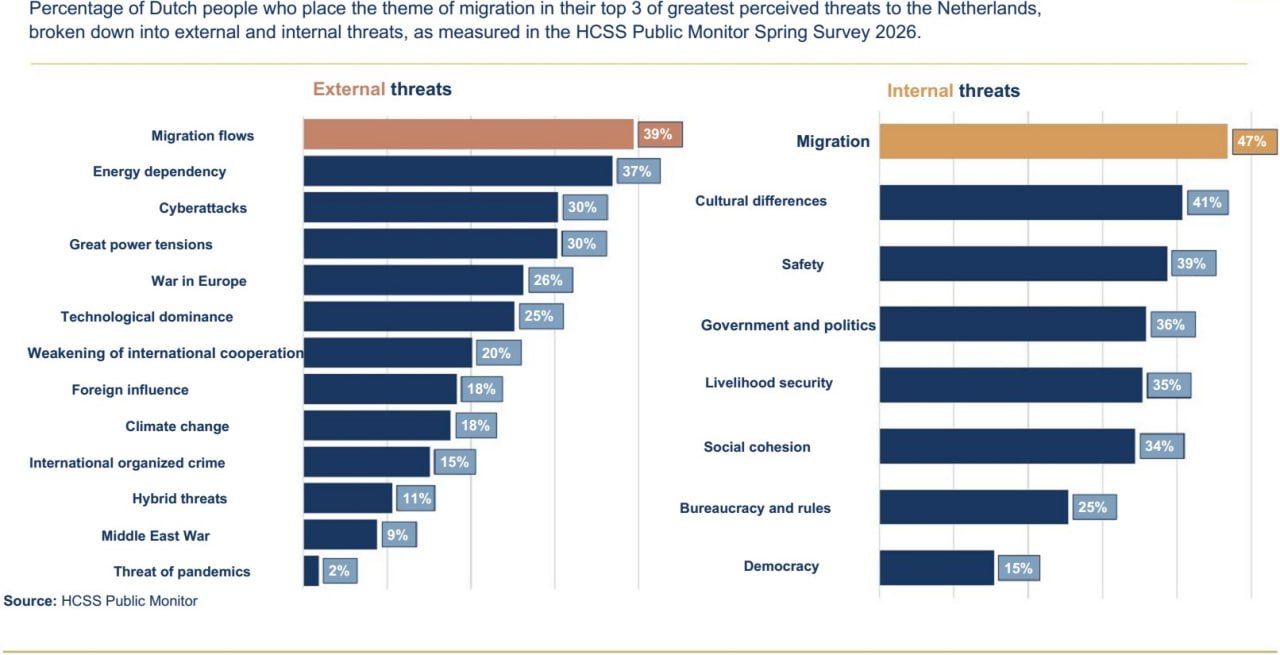
Source: https://hcss.nl/report/hcss-focus-dreigingssentiment-migratie/